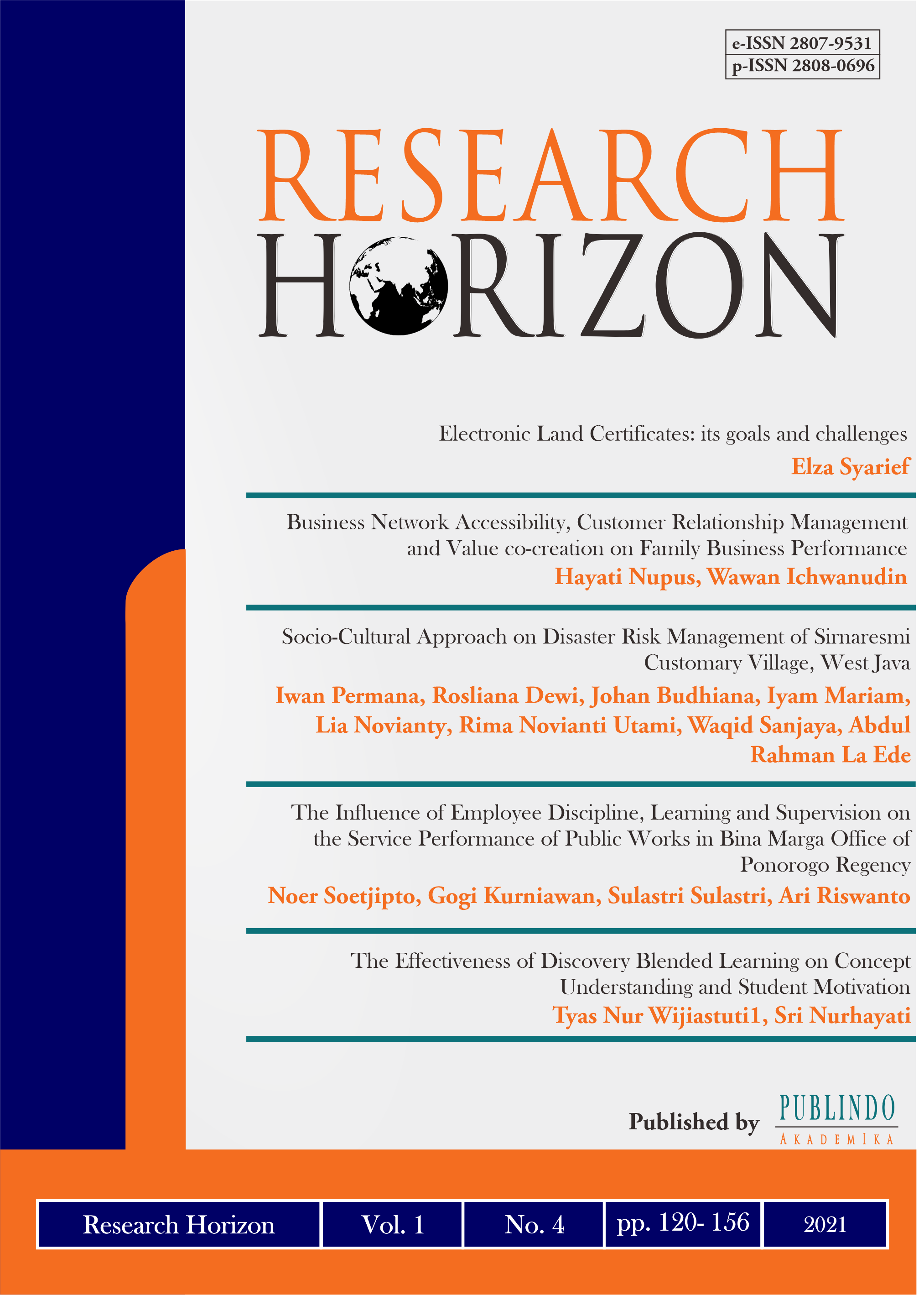
Business Network Accessibility, Customer Relationship Management and Value Co-creation on Family Business Performance
DOI:
https://doi.org/10.54518/rh.1.4.2021.22Keywords:
customer relationship management, business network accessibility, value co-creation, family distribution network, marketing performanceAbstract
This study aims to analyze the effect of customer relationship management (CRM) capability, business network accessibility (BNA), and value co-creation (VCC) on the improvement of familial distribution network (FDN). In addition, this study also analyzes the influence of customer relationship management (CRM), familial distribution network (FDN), business network accessibility (BNA), and value co-creation (VCC) on improving marketing performance (MP). The results of the study show that the accessibility of the business network has a positive contribution to the strength of the familial distribution network and marketing performance, the strength of the family distribution network has a positive contribution to the marketing performance. In addition, the combination of social networking and customer relationship management provides a great opportunity to enrich customer interactions and provide businesses with a way to manage and measure how they use social networks while successfully attracting social customers.
Downloads
References
Ahn, J. H., Lee, D. J., & Lee, S. Y. (2006). Balancing business performance and knowledge performance of new product development: Lessons from ITS industry. Long range planning, 39(5), 525-542.
Ali, R., Ali, S., Ahmad, M., & Nazish, Z. (2019). Impact of CRM capability dimensions on organizational performance. SMART Journal of Business Management Studies, 15(2), 80-88.
Corstjens, M., & Doyle, P. (1979). Channel optimization in complex marketing systems. Management Science, 25(10), 1014-1025.
Edvardsson, B., Tronvoll, B., & Gruber, T. (2011). Expanding understanding of service exchange and value co-creation: a social construction approach. Journal of the academy of marketing science, 39(2), 327-339.
Ehrenthal, J. C. (2012). A Service-Dominant Logic view of retail on-shelf availability (Doctoral dissertation, Rohner+ Spiller AG).
Ferdinand, P. (2014). Rising powers at the UN: an analysis of the voting behaviour of BRICS in the General Assembly. Third World Quarterly, 35(3), 376-391.
Fischer, E., & Reuber, A. R. (2003). Support for rapid‐growth firms: a comparison of the views of founders, government policymakers, and private sector resource providers. Journal of small business management, 41(4), 346-365.
Florin, J., Lubatkin, M., & Schulze, W. (2003). A social capital model of high-growth ventures. Academy of Management Journal, 46(3), 374-384.
Granovetter. (1983). The strength of weak ties: A network theory revisited. In Schlüsselwerke der Netzwerkforschung (pp. 243-246). Springer VS, Wiesbaden.
Grönroos, C. (2000). Creating a relationship dialogue: communication, interaction and value. The marketing review, 1(1), 5-14.
Grönroos, C., & Helle, P. (2012). Return on relationships: conceptual understanding and measurement of mutual gains from relational business engagements. Journal of Business & Industrial Marketing.
Handani, N. D. (2021). Product Awareness of International Muslim Students in South Korea about the Importance of Halal Food. Research Horizon, 1(1), 1-6.
Jarillo, J. C. (1989). Entrepreneurship and growth: The strategic use of external resources. Journal of business venturing, 4(2), 133-147.
Kim, K., McKay, R. I., & Moon, B. R. (2010, July). Multiobjective evolutionary algorithms for dynamic social network clustering. In Proceedings of the 12th annual conference on Genetic and evolutionary computation (pp. 1179-1186).
Morgan, N. A., Vorhies, D. W., & Mason, C. H. (2009). Market orientation, marketing capabilities, and firm performance. Strategic management journal, 30(8), 909-920.
Naylor, J. B., Naim, M. M., & Berry, D. (1999). Leagility: Integrating the lean and agile manufacturing paradigms in the total supply chain. International Journal of production economics, 62(1-2), 107-118.
Nupus, H., & Ichwanudin, W. (2020). Integrated paradigm of lean supply chain of SMEs by utilizing customer relationship management capabilities and family distribution networks. International Journal of Supply Chain Management 9(2), pp. 93-103
Parvatiyar, A., & Sheth, J. N. (2001). Customer relationship management: Emerging practice, process, and discipline. Journal of Economic & Social Research, 3(2).
Payne, A. F., Storbacka, K., & Frow, P. (2008). Managing the co-creation of value. Journal of the academy of marketing science, 36(1), 83-96.
Payne, A., & Frow, P. (2005). A strategic framework for customer relationship management. Journal of marketing, 69(4), 167-176.
Prahalad, C. K., & Ramaswamy, V. (2000). Co-opting customer competence. Harvard business review, 78(1), 79-90.
Riswanto, A. (2021). Competitive Intensity, Innovation Capability and Dynamic Marketing Capabilities. Research Horizon, 1(1), 7-15.
Sadma, O. (2021). The Role of Environmental-Based “Green Startup” in Reducing Waste Problem and its Implication to Environmental Resilience. Research Horizon, 1(3).
Sarner, A., Thompson, E., Drakos, N., Fletcher, C., Mann, J., & Maoz, M. (2011). Magic quadrant for social CRM. Gartner, Stamford.
Sobar, A., Deni, A. ., Riswandi, R. ., Hamidi, D. Z. ., & Permadi, I. (2021). The Effect of Product Turnover on Company Performance of SMEs. Research Horizon, 1(3), 115–119.
Vargo, S. L., & Lusch, R. F. (2004). Evolving to a new dominant logic for marketing. Journal of marketing, 68(1), 1-17.
Vorhies, D. W. & Morgan, N. A. (2005). Benchmarking marketing capabilities for sustained competitive advantage. Journal of Marketing. 69(1): 80-94.
Wang, Y., & Feng, H. (2012). Customer relationship management capabilities: Measurement, antecedents and consequences. Management Decision.
Zhao, L., & Aram, J. D. (1995). Networking and growth of young technology-intensive ventures in China. Journal of business venturing, 10(5), 349-370.
Downloads
Published
How to Cite
Issue
Section
License
Copyright (c) 2021 Research Horizon

This work is licensed under a Creative Commons Attribution-ShareAlike 4.0 International License.