
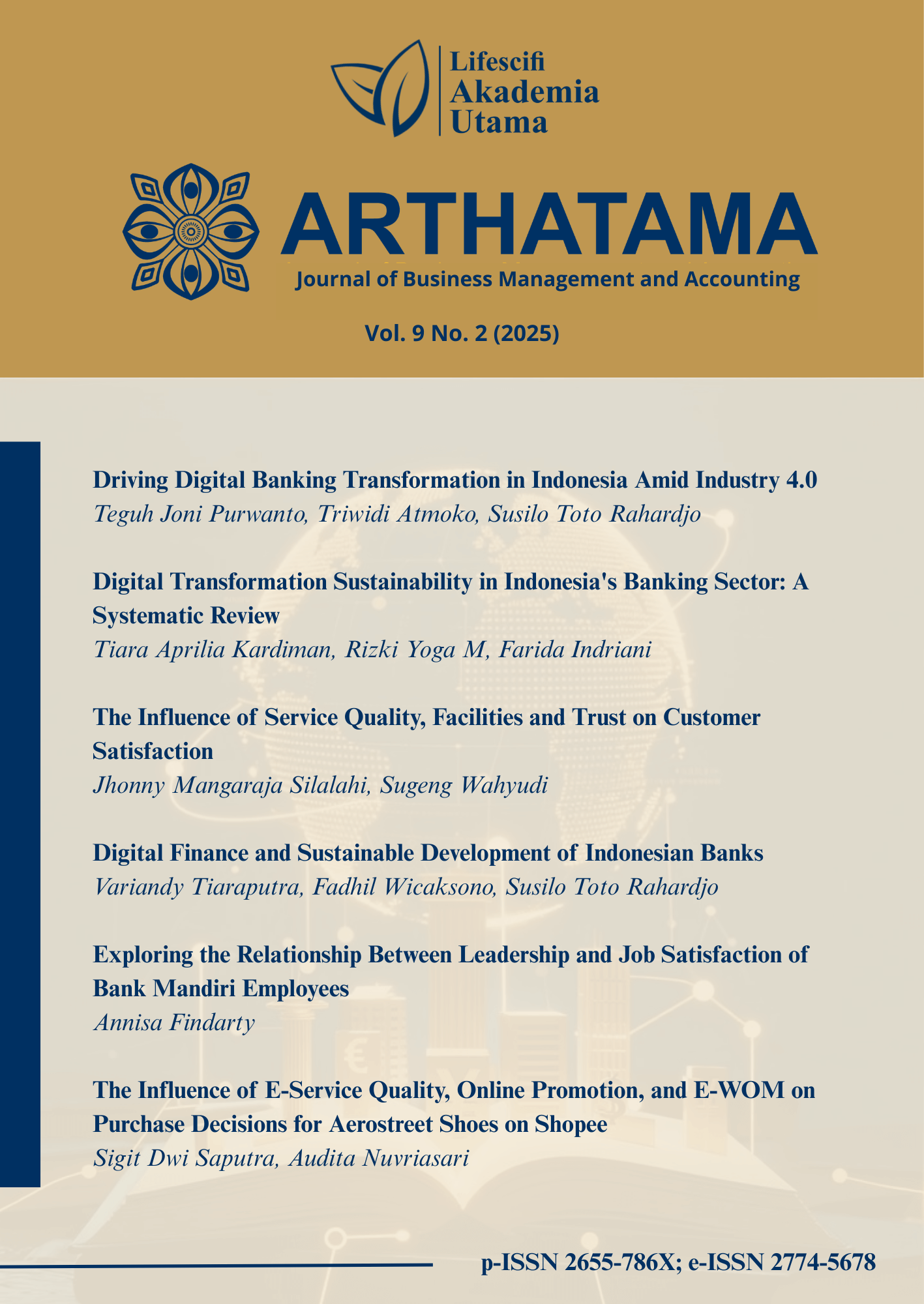
Driving Digital Banking Transformation in Indonesia Amid Industry 4.0
DOI:
https://doi.org/10.54518/art.9.2.2025.699Keywords:
Banking, Digital Transformation, Electronic Transactions, Industrial Revolution 4.0Abstract
The study emphasizes the role of regulatory frameworks and government initiatives in accelerating digital transformation within the banking sector. The Indonesian Financial Services Authority and Bank Indonesia have introduced various policies to support innovation while ensuring consumer protection and financial system stability. In addition, the research explores how customer behavior is shifting toward digital channels, driven by convenience, speed, and accessibility. This behavioral shift necessitates banks to invest in user-friendly digital platforms and robust IT infrastructure. The study also discusses the importance of digital literacy among consumers and employees to maximize the benefits of digital banking. Moreover, collaboration between traditional banks and fintech companies is identified as a key strategy to foster innovation and expand financial inclusion. By addressing both opportunities and risks, this research provides a comprehensive perspective on how Indonesian banks can effectively implement digital transformation strategies. The insights gained are expected to guide policymakers, financial institutions, and stakeholders in shaping a resilient and inclusive digital banking ecosystem.
References
Ahmed, B. A. (2020). Impact of COVID-19 Pandemic on Global Economy. Rochester: Social Science Research Network.
Ajupov, A. A., Ahmadullina, A. A., Belyaev, R. M., & Sizova, A. I. (2019). Assessment of the level of development of digital technologies in the banking sector. Helix, 9(4), 5248.
Anam, C., & Ei, M. (2018). E-Money (uang elektronik) dalam perspektif Hukum Syari’ah. Qawãnïn Journal of Economic Syaria Law, 2(1), 95-112.
Auge-Dickhut, S., Koye, B., Liebetrau, A., Auge-Dickhut, S., Koye, B., & Liebetrau, A. (2016). Business Models of Banks. Customer Value Generation in Banking: The Zurich Model of Customer-Centricity, 91-109.
Bellini, F., & Dulskaia, I. (2017). A digital platform as a facilitator for assessing innovation potential and creating business models: a case study from the i3 project. In Proceedings of the International Conference on Business Excellence (Vol. 11, No. 1, pp. 982-993). Sciendo.
Borges, G. L., Marine, P., & Ibrahim, D. Y. (2020). Digital transformation and customers services: the banking revolution. International Journal of Open Information Technologies, 8(7), 124-128.
Butt, M. W., & Butt, U. J. (2020). Digitalisation of the Global FinTech Industry. In Handbook of Research on Innovations in Technology and Marketing for the Connected Consumer (pp. 431-449). IGI Global Scientific Publishing.
Chakraborty, I., & Maity, P. (2020). COVID-19 outbreak: Migration, effects on society, global environment and prevention. Science of the total environment, 728, 138882.
Chiorazzo, V., D'Apice, V., DeYoung, R., & Morelli, P. (2018). Is the traditional banking model a survivor?. Journal of Banking & Finance, 97, 238-256.
Dang, V. D. (2020). Do non-traditional banking activities reduce bank liquidity creation? Evidence from Vietnam. Research in International Business and Finance, 54, 101257.
Devi, B. R. (2020). Innovations in banking sector - e-banking products. Journal of Emerging Technologies and Innovative Research, 9(3), 271-282.
Farida; Binastuti, Sugiharti; Silfianti, Widya; Hermana, Budi. (2023). The impact of Covid-19 on electronic payment system: Lesson learned from Indonesian banking. Technium Soc. Sci. J., 40, 200.
Hidayatullah, D. R., Darmawan, A., & Kallidumban, S. (2020). Finding the strategy after corona crisis: the new normal and resilient economy growth in indonesia. International Journal of Economics, Business, and Entrepreneurship, 3(1), 64-79.
Hrytsiuk, N., & Sak, T. (2021). Impact of the COVID-19 pandemic on the global economy (Vplyv pandemii COVID-19 na svitovu ekonomiku). Economic Scope, 165, 33-38.
Indrawati, S. M., Diop, N., Ikhsan, M., & Kacaribu, F. (2020). Enhancing resilience to turbulent global financial markets: An Indonesian experience. Economics and Finance in Indonesia, 66(1), 47-63.
Luković, S., & Stojković, D. (2020). Covid-19 pandemic and global tourism. Менаџмент у хотелијерству и туризму, 8(2), 79-87.
Luthfiatussa’dyah, D., Kosim, A. M., & Devi, A. (2023). Strategi Optimalisasi Digitalisasi Produk Perbankan pada Bank Syariah Indonesia. El-Mal: Jurnal Kajian Ekonomi & Bisnis Islam, 4(3), 783-802.
Mariani, L. A., Ornelas, J. R., & Ricca, B. (2023). Banks’ Physical Footprint and Financial Technology Adoption, 5(3), 801-810.
Martin, V. (2019). Reshaping the banking industry through digital transformation. FINIZ 2019-Digitization and Smart Financial Reporting, 7(3), 131-136.
Mubin, S. A. P. M. K., & Pambudi, S. A. (2020). Analysis the effect of electronic money use on velocity of money: Evidence from Indonesia. Jurnal Ilmu Ekonomi Terapan, 5(1), 42.
Mutiara, U., Candanni, L. R., & Hasibuan, R. R. (2019). Construction of Financial Technology in Banking Systems in Indonesia. Jurnal Hukum NOVELTY, 10(02), 150-163.
Nagorny, P. (2020). Bank without Branches: Digitalization of Society and Fintech Technologies of the Present and Future. Accounting & Finance/Oblìk ì Fìnansi, (89)2, 1783-1802.
Nagy, G., Bányai, Á., & Illés, B. (2020). The impact of the pandemic on global logistics processes. Advanced Logistic Systems-Theory and Practice, 14(1), 39-48.
Niemand, T., Rigtering, J. C., Kallmünzer, A., Kraus, S., & Maalaoui, A. (2021). Digitalization in the financial industry: A contingency approach of entrepreneurial orientation and strategic vision on digitalization. European management journal, 39(3), 317-326.
Purba, J. T., Samuel, S., & Budiono, S. (2021). Collaboration of digital payment usage decision in COVID-19 pandemic situation: Evidence from Indonesia. International Journal of Data & Network Science, 8(4), 1317-1326.
Ramadhani, R. (2024). Big Data in Digital Transformation of Corporate Marketing Strategy. Economic and Business Horizon, 3(1), 24-28.
Riyanto, A., Primiana, I., & Azis, Y. (2018, August). Disruptive technology: the phenomenon of FinTech towards conventional banking in Indonesia. In IOP Conference Series: Materials Science and Engineering. Bristol: IOP Publishing.
Said, A. I., & Angelita, M. (2020, August). Determining Factors for Success of Banking Digital Transformation. In 3rd Asia Pacific Management Research Conference. Dordrecht: Atlantis Press.
Schwertner, K. (2017). Digital transformation of business. Trakia Journal of Sciences, 15(1), 388-393.
Shabri, H., Azlina, N., & Said, M. (2022). Transformasi digital industri perbankan syariah Indonesia. El-Kahfi| Journal of Islamic Economics, 3(2), 81-102.
Shashikala, K. (2019). Digital disruption in banking industry. International Journal of Social and Economic Research, 15(2), 2388-2393
Sheikh, A., Ghanbarpour, T., & Gholamiangonabadi, D. (2019). A preliminary study of fintech industry: a two-stage clustering analysis for customer segmentation in the B2B setting. Journal of Business-to-Business Marketing, 26(2), 197-207.
Siregar, R. Y., Gunawan, A. H., & Saputro, A. N. (2021). Impact of the covid-19 shock on banking and corporate sector vulnerabilities in Indonesia. Bulletin of Indonesian Economic Studies, 57(2), 147-173.
Soenjoto, W. P. P. (2022). Analisa Kemitraan Perbankan Pada Pelaku Usaha Mikro Di Era Digital. Reinforce: Journal of Sharia Management, 1(1), 64-80.
Teja, A. (2017). Indonesian fintech business: New innovations or foster and collaborate in business ecosystems?. The Asian Journal of Technology Management, 10(1), 10-22.
Triggs, A., Kacaribu, F., & Wang, J. (2019). Risks, resilience, and reforms: Indonesia’s financial system in 2019. Bulletin of Indonesian Economic Studies, 55(1), 1-27.
Trisnowati, Y., Muditomo, A., Manalu, E. P., & Adriana, D. (2020, August). The COVID-19 Pandemic's Impact on Indonesia's Electronic Retail Payment Transactions. In 2020 International Conference on Information Management and Technology (ICIMTech). IEEE.
Widarwati, E., Solihin, A., & Nurmalasari, N. (2022). Digital finance for improving financial inclusion Indonesians’ banking. Signifikan: Jurnal Ilmu Ekonomi, 11(1), 17-30.
Widharto, P., Pandesenda, A. I., Yahya, A. N., Sukma, E. A., Shihab, M. R., & Ranti, B. (2020). Digital Transformation of Indonesia Banking Institution: Case Study of PT. BRI Syariah. In 2020 International conference on information technology systems and innovation (ICITSI). IEEE.
Wulandari, P. (2024). The Role of Islamic Banking in the Indonesian Economy. Economic and Business Horizon, 3(1), 13-17.
Yucel, S. (2018). Modeling digital business strategy. In 2018 International Conference on Computational Science and Computational Intelligence (CSCI). IEEE.
Zayed, N. M., Khan, S., Shahi, S. K., & Afrin, M. (2021). Impact of coronavirus (COVID-19) on the world economy, 2020: A conceptual analysis. Journal of Humanities, Arts and Social Science, 5(1), 1-5.
Downloads
Published
How to Cite
Issue
Section
License

This work is licensed under a Creative Commons Attribution-ShareAlike 4.0 International License.
This is a state of publication that makes writers respect the copyright of their articles and enables us to ensure full copyright protection and to disseminate international journals. Authors are asked to transfer copyrights to ensure the widest possible dissemination of information. Notification will be sent to the relevant Author who confirms receipt of the manuscript. If citations from other copyrighted works are included, the Author must obtain written permission from the copyright owner and give credit to the source in the article.


