
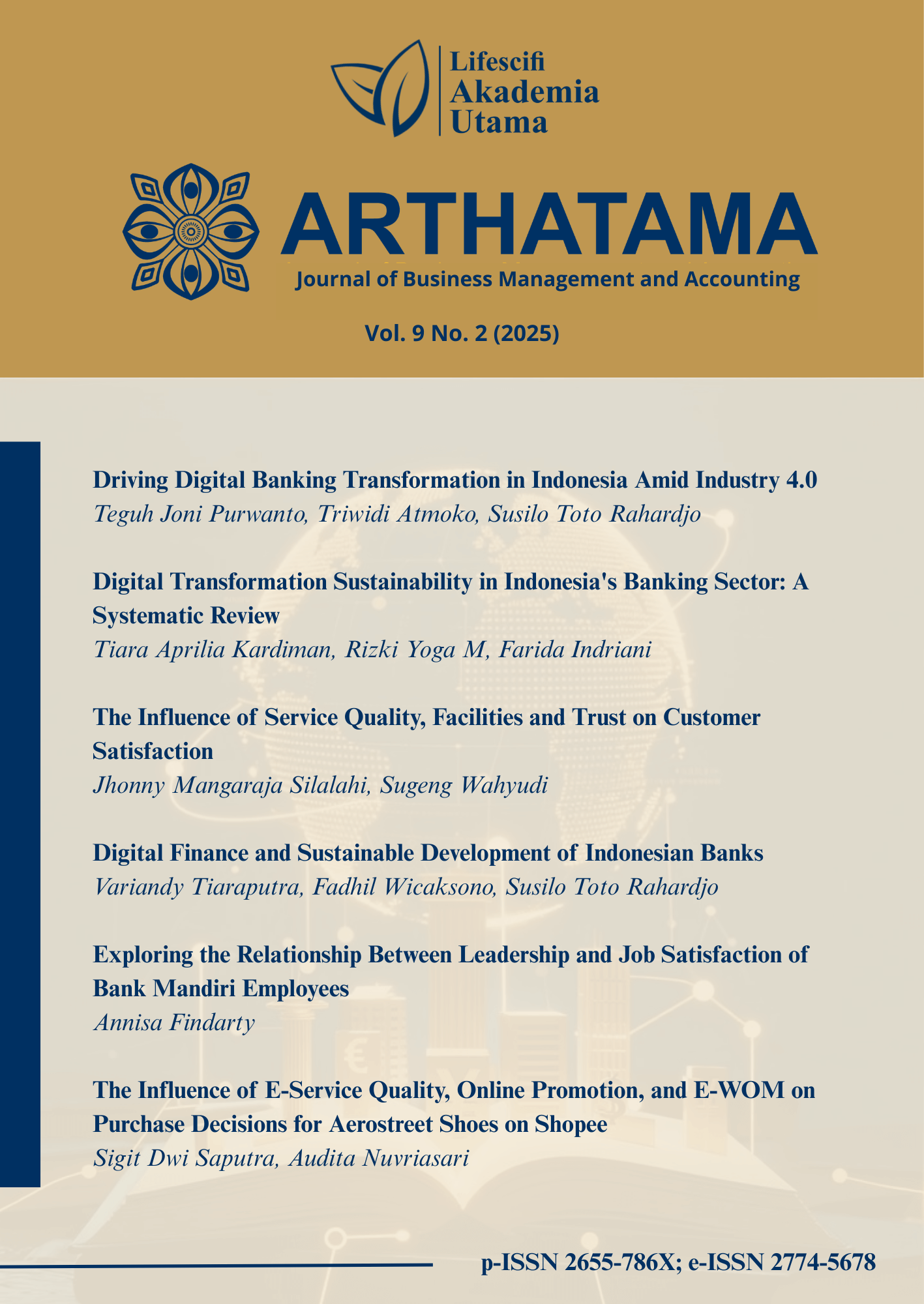
Exploring the Relationship Between Leadership and Job Satisfaction of Bank Mandiri Employees
DOI:
https://doi.org/10.54518/art.9.2.2025.623Keywords:
Bank Mandiri, Human Resource Management, Job Satisfaction, Leadership, Systematic Literature ReviewAbstract
Leadership significantly influences employee job satisfaction, shaping a productive work environment and supporting organizational success in the competitive banking sector. This study aims to examine the relationship between leadership styles and employee job satisfaction at Bank Mandiri, a leading Indonesian bank, by analyzing how leadership practices impact employee well-being and retention. The research employed a Systematic Literature Review, analyzing 30 peer-reviewed journal articles published between 2019 and 2024, sourced from databases like Scopus and ScienceDirect. The findings reveal a strong positive correlation between transformational and participative leadership styles and employee job satisfaction, driven by open communication, recognition, and employee involvement in decision-making. In contrast, authoritarian leadership often reduces satisfaction due to limited autonomy. These results highlight the importance of adaptive leadership in fostering a motivated workforce. The study concludes that Bank Mandiri should prioritize leadership training programs focusing on transformational and participative approaches to enhance employee satisfaction and organizational performance. By addressing these leadership practices, the bank can strengthen its human resource management strategies, ensuring a balance between achieving business goals and promoting employee well-being in a dynamic industry.
References
Aisyah, N. (2024). Pengaruh kepemimpinan dan motivasi terhadap kinerja pegawai melalui kepuasan kerja pada PT. Bank Mandiri (Persero), Tbk Micro Banking Cluster Makassar Kartini (Doctoral dissertation, Makassar: Universitas Hasanuddin).
Alfredo, W. A., Widiyanti, M., Yusuf, M., & Hadjri, M. I. (2020). The influence of leadership style and organisational culture on employee performance at PT Bank Mandiri (Persero) Tbk Palembang Area Arief. International Journal of Business, Economics and Management, 7(3), 138–142.
Aljumah, A. (2023). The impact of extrinsic and intrinsic motivation on job satisfaction: The mediating role of transactional leadership. Cogent Business & Management, 10(3), 799-813.
Anom, A., Adawiyah, W. R., & Berliyanti, D. O. (2023). Job satisfaction karyawan perbankan memediasi transformational leadership dan job performance. J-MAS (Jurnal Manajemen dan Sains), 8(1), 709–721.
Avolio, B. J., & Bass, B. M. (2020). Developing potential across a full range of leadership: Cases on transactional and transformational leadership. New York, NY: Psychology Press.
Fahmi, I. (2020). Manajemen sumber daya manusia: Teori dan aplikasi. Bandung: Alfabeta.
Fatahuddin, A. F., & Tanuwijaya, J. (2022). Pengaruh leadership style dan organizational culture terhadap employee performance melalui job satisfaction sebagai variabel mediasi pada karyawan PT. Bank Mandiri Unit SME & Micro Risk Group. Jurnal Ilmiah Manajemen, Ekonomi, & Akuntansi (MEA), 6(2), 351–374.
Hilton, S. K., Madilo, W., Awaah, F., & Arkorful, H. (2023). Dimensions of transformational leadership and organizational performance: The mediating effect of job satisfaction. Management Research Review, 46(1), 1–19.
Idris, M., Atika, U. F., & Hidayat, R. (2024). The influence of work motivation and work environment on job satisfaction and its impact on the performance of Bank Mandiri employees Palembang city. Revista de Gestão Social e Ambiental, 18(6), 1–27.
Ismail, A., & Daud, Z. (2022). Transformational leadership and job satisfaction among employees in the banking sector. International Journal of Business and Society, 23(1), 1–14.
Kundu, S. C., Kumar, S., & Gahlawat, N. (2019). Empowering leadership and job performance: Mediating role of psychological empowerment. Management Research Review, 42(5), 605–624.
Kusuma, A. D., & Prasetyo, A. (2021). The relationship between leadership style and job satisfaction of banking employees. Journal of Management and Entrepreneurship, 23(1), 54–62.
Lukman, B., & Prijono, B. (2022). The role of leadership style and social work environment toward employee engagement at Bank Mandiri Ujung Menteng Branch. Management Research Studies Journal, 3(1), 10–24.
Luthans, F. (2021). Organizational behaviour: An evidence-based approach (14th ed.). New York, NY: McGraw-Hill Education.
Magasi, C. (2021). The role of transformational leadership on employee performance: A perspective of employee empowerment. European Journal of Business and Management Research, 6(6), 21–28.
Mutmainnah, L., & Cahyadi, A. (2023). Participative leadership and its impact on job satisfaction in the banking sector. Journal of Business Administration, 21(3), 210–219.
Mwesigwa, R., Tusiime, I., & Ssekiziyivu, B. (2020). Leadership styles, job satisfaction and organizational commitment among academic staff in public universities. Journal of Management Development, 39(2), 253–268.
Paramita, E., Lumbanraja, P., & Absah, Y. (2020). The influence of organizational culture and organizational commitment on employee performance and job satisfaction as a moderating variable at PT. Bank Mandiri (Persero), Tbk. International Journal of Research and Review, 7(3), 273–286.
Ramadhania, S. U., & Sukarno, G. (2023). Analysis of work-life balance and job satisfaction on employee performance at Bank Mandiri Kupang Branch Office. Journal of Digital Economics and Business, 2(3), 805–816.
Rizqulloh, A. D. B., & Kuncoro, W. A. (2022). Exploring the impact of work-life balance, job satisfaction, and training on employee performance: A literature review. Arthatama: Journal of Business Management and Accounting, 6(2), 76–87.
Robbins, S. P., & Judge, T. A. (2019). Organizational behaviour (18th ed.). London: Pearson Education.
Sari, P. D., & Nugroho, S. (2020). Leadership style and employee job satisfaction: A study on government banks. Journal of Management Science and Business, 11(1), 75–85.
Setiawan, D., & Rahmawati, A. (2024). Transformational leadership and job satisfaction: A systematic literature study. Journal of Applied Management, 14(1), 30–41.
Sofyandi, H. (2020). Theory and practice of leadership in organisations. Yogyakarta: Graha Ilmu.
Sugiyono. (2022). Metode penelitian kombinasi (Mix methods). Bandung: Alfabeta.
Sulistio, A., & Darmastuti, I. (2022). Employee empowerment and job satisfaction: A literature review. Arthatama: Journal of Business Management and Accounting, 6(2), 66–75.
Supriyanto, A. S., & Eka, R. D. (2023). The effect of leadership on job satisfaction: A meta-analysis study. Journal of Industrial and Organisational Psychology, 19(2), 85–98.
Utami, R., & Dewi, I. T. T. (2024). The influence of career development and motivation on employee job satisfaction at PT Bank Mandiri (Persero) Tbk case study at Mandiri University Group. International Journal of The Newest Social and Management Research, 2(2), 164–177.
Widyo, D., Indrajaya, M. G., & Ratnawati, I. (2023). The role of empowering leadership in enhancing employee performance. Arthatama: Journal of Business Management and Accounting, 7(1), 20–29.
Wijayati, D. T., Rahman, Z., Fahrullah, A. R., Rahman, M. F. W., Arifah, I. D. C., & Kautsar, A. (2022). A study of artificial intelligence on employee performance and work engagement: The moderating role of change leadership. International Journal of Manpower, 43(2), 486–512.
Yukl, G. A. (2020). Leadership in organizations (9th ed.). London: Pearson Education.
Downloads
Published
How to Cite
Issue
Section
License
Copyright (c) 2025 Author(s)

This work is licensed under a Creative Commons Attribution-ShareAlike 4.0 International License.
This is a state of publication that makes writers respect the copyright of their articles and enables us to ensure full copyright protection and to disseminate international journals. Authors are asked to transfer copyrights to ensure the widest possible dissemination of information. Notification will be sent to the relevant Author who confirms receipt of the manuscript. If citations from other copyrighted works are included, the Author must obtain written permission from the copyright owner and give credit to the source in the article.


